
Carriage of goods by sea plays a key role in international trade, mainly because it is economically, geographically and practically efficient. In particular, when large volumes of cargo are carried over long distances, sea transport can be more advantageous than land transport. Land carriage may involve crossing state borders, customs procedures, various duties and documentation requirements, all of which add time and cost. Sea carriage, by contrast, directly connects continents and allows large volumes of cargo to be moved at a lower unit transport cost. Moreover, some of the risks on sea routes can be anticipated and managed in advance.
Alongside its economic importance, the legal regulation of carriage by sea is of particular relevance. Historically, carriers' obligations and liability were defined in order to ensure the safety of goods carried by sea. Under earlier approaches, a carrier could bear broad liability for loss of or damage to cargo, while circumstances such as force majeure, irresistible natural events and, in some cases, acts of pirates were considered grounds for exemption from liability. The application of these grounds depended on the relevant legal conditions and evidentiary requirements. The development of maritime transport law is therefore important for striking a balance between the interests of carriers and the protection of cargo owners' rights.
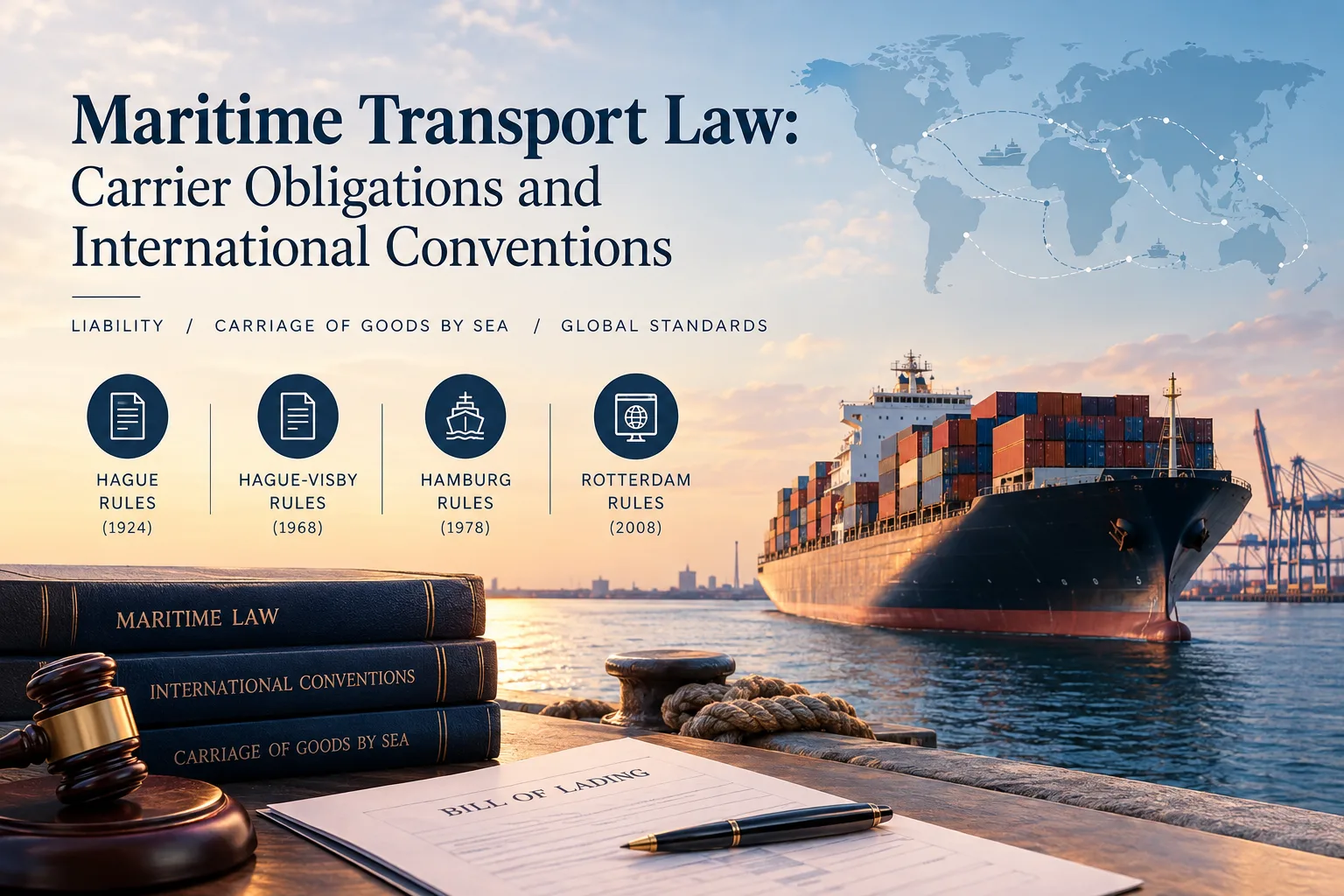
To address these problems, a need arose for uniform legal standards at international level. The aim was not only to remove differences between national laws, but also to prevent carriers from excessively limiting their liability through contract terms and to maintain a balance of interests between the cargo owner and the carrier. One of the first major steps in this direction was the adoption of the Hague Rules in 1924. The main purpose of the Hague Rules was to define the carrier's obligations and liability through uniform rules. Under these rules, the carrier must make the ship seaworthy, properly man and equip it, and ensure that the holds in which the cargo is stowed are fit for carriage. At the same time, the loading, stowage, carriage, care and discharge of the cargo must be carried out properly. The Hague Rules also set out the carrier's obligation to issue the shipper with a bill of lading — the document issued by the carrier in sea transport that confirms the details of the cargo carried. On the other hand, the rules do not allow the carrier to be fully exempted from liability. Although the carrier may be relieved of liability in certain cases, contract terms that exclude its liability contrary to the Hague Rules are not permitted. The rules thus take the carrier's rights and interests into account on the one hand, and seek to protect the cargo owner on the other.
Under the Hague Rules, the carrier's liability covered the period between loading and discharge of the cargo. The carrier had to keep the ship seaworthy, carry the cargo properly and not deviate unreasonably from the route provided for in the contract. Where cargo was damaged, the key question was which party bore the burden of proof. The consignee had to prove the loss and the circumstances giving rise to the carrier's liability. Here the bill of lading played an important role: if it recorded that the cargo was in apparent good order and condition, this could serve as evidence that the cargo had been handed to the carrier in that condition. The carrier could then rely on the grounds for exemption from liability. It had to show that it had taken the necessary steps to make the ship seaworthy, or that the loss resulted from one of the excepted perils provided for in the Hague Rules. If the cargo owner proved that the carrier's own acts had also contributed to the loss, the question of liability could be reassessed. The burden of proof under the Hague Rules was therefore shared between the parties. Nevertheless, because the rules gave the carrier broad exceptions, they have historically been regarded as a regime that mainly protected the carrier's interests.
Because the Hague Rules favoured the carrier and there was dissatisfaction with the limitation of liability, the Hague-Visby Rules were later adopted. These amendments widened the scope of application, updated the limits of liability for loss of or damage to cargo, and introduced SDR (Special Drawing Rights) in place of the earlier monetary units. The SDR is a unit of account defined by the International Monetary Fund and calculated on the basis of a basket of currencies. The aim was to prevent liability limits from depending on the currency of a single state and to make their calculation more suitable at international level. However, the Hague-Visby Rules retained some of the exceptions found in the Hague Rules, including the carrier's exemption from liability for errors in the navigation and management of the ship.
Dissatisfaction with the priority given to carriers' interests later led to the adoption of the Hamburg Rules. Adopted in 1978, these rules aimed to strengthen the protection of cargo owners and change the carrier's liability regime. Unlike the Hague and Hague-Visby Rules, under the Hamburg Rules the carrier's liability was linked mainly to loss of, damage to or delay of the cargo while it was in the carrier's charge. To be exempted from liability, the carrier had to prove that it had taken all measures that could reasonably be required to avoid the loss. In addition, the period of the carrier's liability was extended to cover the entire time the cargo was in its charge. Because these rules were not supported by a number of major maritime states, they did not become as widespread as the Hague-Visby Rules.
The Rotterdam Rules were adopted in order to create a more modern approach to the legal regulation of carriage by sea. Adopted in 2008 and opened for signature in 2009, this Convention took into account electronic transport documents, modern methods of carriage and multimodal transport, in which sea carriage is combined with other modes of transport. However, since the number of ratifications required for its application has not been reached, the Convention has not entered into force. Its complex legal mechanisms and issues of alignment with existing national laws are also among the factors that have hindered its wider acceptance.
Carriage by sea may take the form of liner shipping, operated on pre-set routes and schedules, or tramp shipping, arranged on demand. In addition, the parties may conclude an ordinary contract of carriage or a charter party. Depending on the type of charter, the allocation of control over the use, management and operation of the ship changes. These differences matter, because whether an international convention applies depends not only on the name given to the carriage, but on the content of the contract, the existence of a bill of lading and the conditions of application of the relevant convention.
The development from the Hague Rules to the Rotterdam Rules thus reflects attempts to change the balance of liability between the carrier and the cargo owner. At the same time, long-established legal traditions in maritime transport, port practices and the positions of leading shipping states have a significant influence on the adoption of new rules. For this reason, drafting a more modern legal regime that protects the cargo owner's interests more broadly does not mean that it will automatically be widely accepted at international level.
References:
1) R. Goode, H. Kronke, E. McKendrick — Transnational Commercial Law, Carriage of Goods by Sea
2) Arun Kasi — The Law of Carriage of Goods by Sea (2021)
Leave a Comment
Leave a Comment
book an appointment